
Walk through the mechanical floor of almost any commercial building—an office tower, a hospital, a shopping mall, or a busy logistics warehouse—and one thing becomes obvious: the fire protection system never gets a day off. It sits silent most of the time, but when an incident happens, every valve, pump, and connection in that system needs to work instantly. There’s no warm-up period, no second chance.
Among all the components that make up a fire protection network, gate valves play one of the most critical roles. They decide whether water moves—or doesn’t. They isolate pumps, control risers, support system testing, and make maintenance possible without shutting down the entire building. And despite the rise of alternative valve designs, gate valves remain the dependable workhorse for fire protection in commercial buildings.
This article breaks down why gate valves are still the backbone of fire sprinkler systems, where they deliver the biggest impact, and how companies like Fluid Tech Piping Systems (Tianjin) Co., Ltd. supply the kind of UL/FM-level quality that contractors and engineers depend on.
The Demands of a Modern Commercial Fire Protection System
Every commercial building has its own challenges.
A hospital can’t shut down a riser because surgeries are happening two floors up.
A mall may have hundreds of tenants, each with different sprinkler layouts.
A warehouse could have long branch lines and high ceilings that need reliable water pressure.
But regardless of building type, fire protection systems must excel in three areas:
- Uninterrupted water supply
- Dependable shutoff and isolation
- Long-term stability under pressure
Gate valves check all three boxes.
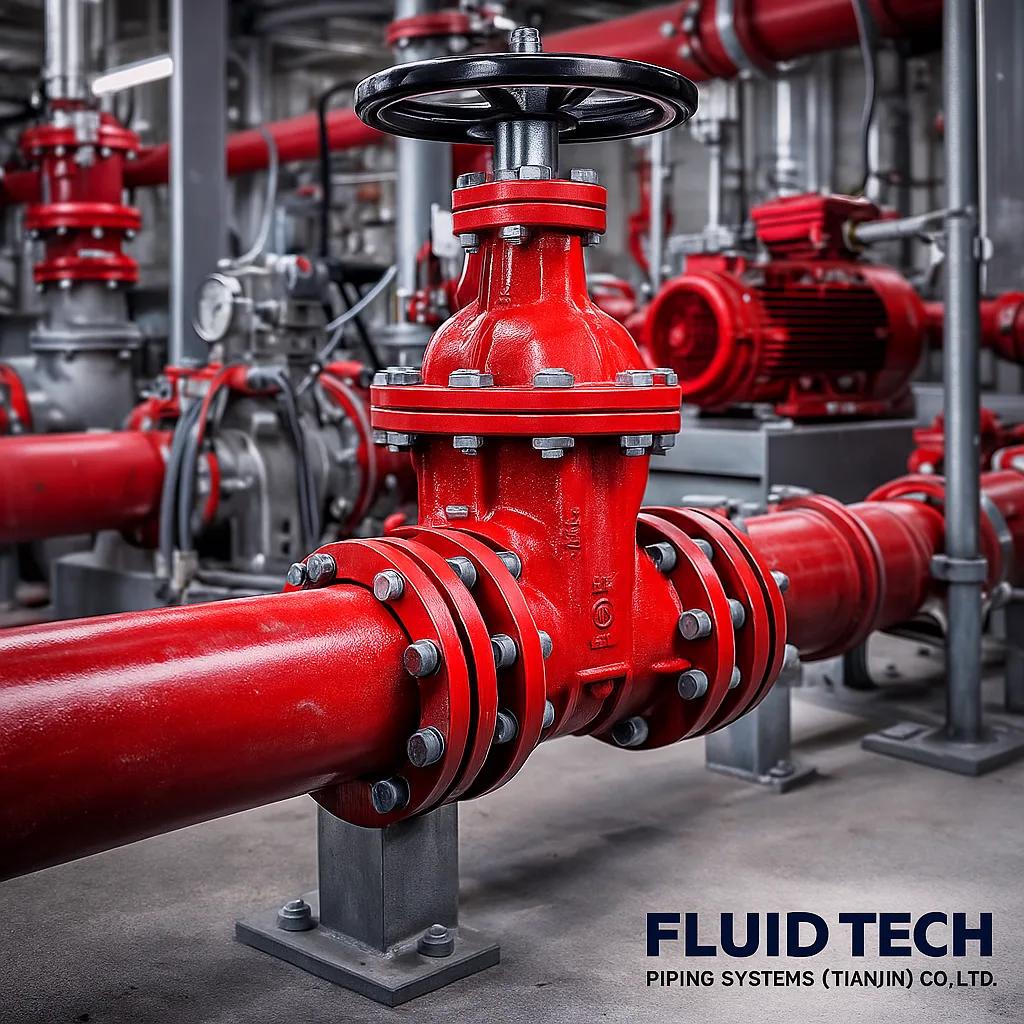
What Makes Gate Valves So Important?
Unlike butterfly valves—which are great for certain applications but add flow resistance—gate valves offer a full-open, full-close operation. When open, the waterway is almost straight-through. When closed, shutting off is firm and positive.
This simple mechanism is precisely what fire protection networks need.
Gate Valves Provide Reliable Isolation in Pump Rooms
If there’s one place where reliability matters above all else, it’s the fire pump room. Pumps must be tested regularly. Backflow preventers require maintenance. Controllers need inspection.
Without gate valves:
- The entire system might need to be shut down
- Testing becomes disruptive
- Repairs create long delays
- Fire risk increases during isolation
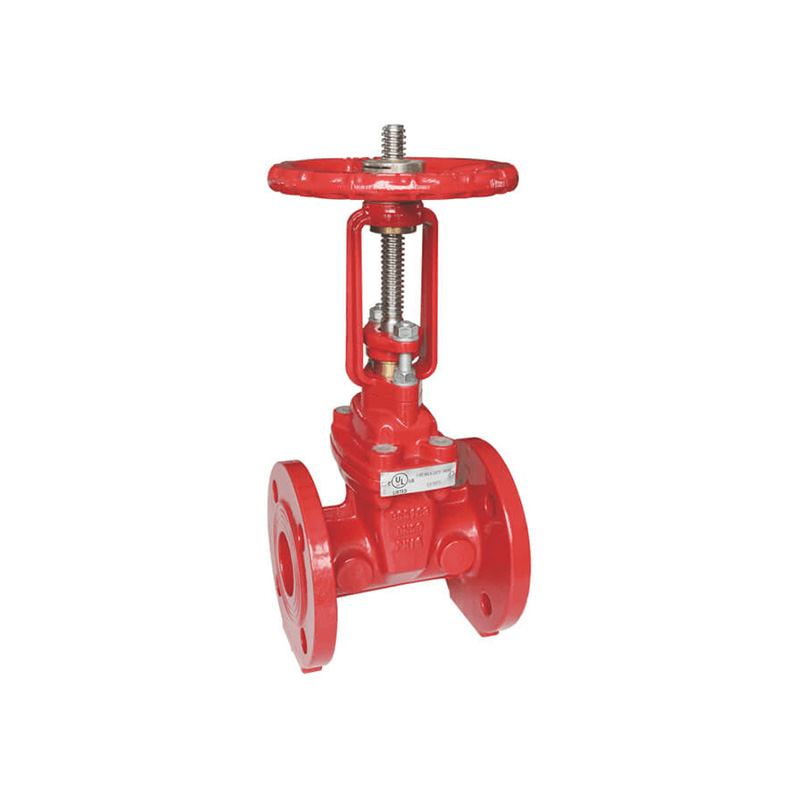
Gate valves—especially OS&Y (Outside Screw & Yoke) styles—offer clear visual indication of open/closed position, a requirement in many fire codes. They are the standard isolation method for pumps, header systems, test loops, and bypass line setups.
UL/FM-approved gate valves supplied by Fluid Tech are specifically designed for this environment, featuring durable ductile-iron bodies, strong wedge mechanisms, and corrosion-resistant coatings tailored for pump room humidity.
They Perform Exceptionally Well in Wet Fire Sprinkler Systems
Wet sprinkler systems are the most common in commercial buildings. These systems sit pressurized, waiting for a sprinkler head to activate.
Gate valves support this network by:
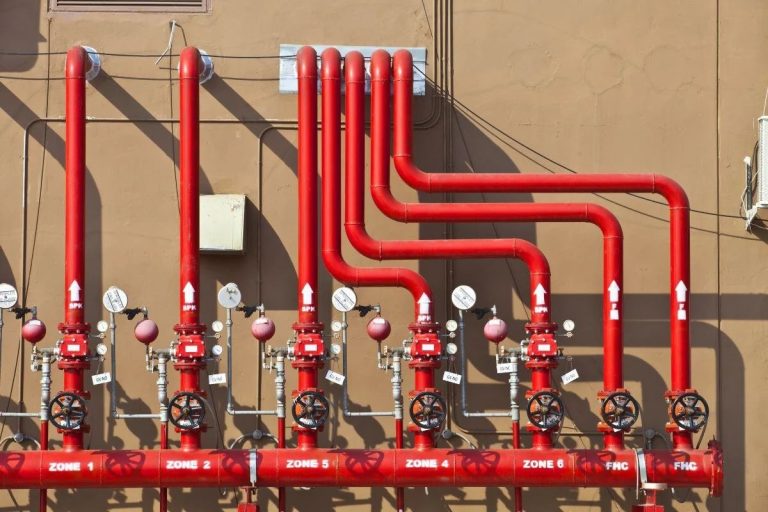
- Isolating floor zones
- Controlling main feeders
- Allowing hydrostatic testing
- Providing dependable shutoff during tenant renovations
A key advantage: gate valves introduce minimal flow resistance, helping maintain water delivery speed—crucial when sprinkler heads open in a fire. Their smooth internal flow path reduces turbulence, which helps maintain pressure consistency in tall buildings.
Gate Valves Are Indispensable in Dry and Preaction Systems
Dry systems are typically used in cold environments—parking garages, loading docks, unheated storage areas—where water inside pipes could freeze.
Here, gate valves must:
- Remain leak-free despite pressure variations
- Keep air pressure stable
- Provide clean isolation for system tests
- Survive long idle periods without sticking
Because a dry system’s reliability hinges on pressure stability, poorly built valves can cause false trips or air leaks. Gate valves with robust sealing designs, such as those manufactured by Fluid Tech, maintain tight shutoff even after years of inactivity.
Gate Valves Handle High Pressure and Water Hammer Better Than Many Alternatives
When fire pumps kick on, the system experiences a quick surge. That surge—known as water hammer—can stress fittings, piping, and valves.
Gate valves handle this better than most designs because:
- Their wedge mechanism distributes force evenly
- The body wall thickness is typically higher
- The straight-through passage reduces pressure shocks
- Ductile iron construction tolerates high stress
Fluid Tech’s valves undergo hydrostatic and seat tests according to strict internal quality control standards to ensure they hold up under these demanding conditions.
Why Contractors and Engineers Prefer Gate Valves in Large Commercial Projects
Ask a fire protection contractor why they specify gate valves, and you’ll hear variations of the same reasons:
- “They last longer in our systems.”
- “Straightforward to install and maintain.”
- “UL/FM listings matter on big jobs.”
- “They seal tightly even after years without movement.”
These practical, jobsite-driven reasons explain why gate valves show up in nearly every major commercial project.
And while butterfly valves are excellent for space-limited areas, gate valves remain the standard for main isolation points, pump manifolds, risers, standpipes, and fire water tanks.
Why Fluid Tech Piping Systems (Tianjin) Co., Ltd. Stands Out
When fire systems depend on valves to function under high pressure and zero-failure tolerance, the manufacturer matters.
Fluid Tech Piping Systems (Tianjin) Co., Ltd. has built a strong reputation in global fire protection and piping markets through:
• International-grade quality (UL/FM level standards)
Their manufacturing process includes rigorous hydrostatic testing, coating inspection, metallurgy checks, and dimensional verification.
• Durable materials and long-life wedge designs
Ductile iron bodies, corrosion-resistant coatings, and precision-machined gates contribute to long service life.
• Reliable shutoff capability
Valves are engineered to close tightly—an essential requirement for pump rooms and riser isolation.
• Global export experience
Products are used in commercial complexes, industrial facilities, municipal projects, and fire protection systems in multiple regions.
• Consistent quality control
Their quality-control procedures—highlighted on the company’s official site—help maintain reliability across mass production.
For B2B buyers, contractors, and system designers, this adds up to fewer callbacks, fewer failures, and a smoother installation experience.
Conclusion
Gate valves might seem simple compared to more modern valve designs, but in fire protection systems—especially those inside large commercial buildings—they remain essential. Their ability to isolate, maintain pressure, withstand surges, and approve visual inspection makes them a trusted choice among engineers, installers, and inspectors worldwide.
When paired with the dependable manufacturing quality of Fluid Tech Piping Systems (Tianjin) Co., Ltd., gate valves deliver the long-term performance fire protection systems require. They help pump rooms operate smoothly, risers stay secure, and sprinkler networks respond exactly as they should in an emergency.
In an environment where reliability can literally save lives, gate valves continue to earn their place at the center of commercial fire protection systems.
FAQs
Why are gate valves preferred in commercial fire protection systems?
Gate valves offer reliable shutoff, minimal flow resistance, and long-term performance under pressure—making them ideal for pump rooms, risers, and main sprinkler lines.
Are gate valves better than butterfly valves for fire systems?
In many cases, yes. For main isolation points, fire pumps, and risers, gate valves provide firmer shutoff and better pressure handling, while butterfly valves are more suitable for tight spaces.
How do gate valves improve the safety of fire protection systems?
They allow clean isolation during inspections or repairs, maintain pressure stability, and withstand water hammer during pump startup, supporting system reliability during emergencies.
Where are gate valves most commonly used in commercial buildings?
They are typically used in fire pump rooms, standpipes, zone control points, sprinkler floor isolations, and wet/dry system risers.
What makes Fluid Tech gate valves a strong choice for contractors?
Their UL/FM-level build quality, durable ductile iron construction, strict quality control, and proven reliability make them a trusted option for large commercial projects.

 Danish
  English
  Arabic
  Spanish
  Italian
  Russian
  Portuguese
  German
  French
  Dutch
Dutch  Japanese
  Vietnamese
  Korean
  Malay
Malay  Thai
Thai  Swedish