Ductile iron grooved fittings with rigorous quality control continue to position themselves as a practical forward choice for sustainable fire safety piping through 2026. Regulations stay on a tightening track—LEED v4.1 keeps raising the bar on embodied carbon, the EU Carbon Border Adjustment Mechanism imposes added costs on high-emission imports, and China’s dual-carbon objectives insist on verifiable lifecycle emission cuts from construction components. Fire protection systems face the reality that reliability during activation and environmental footprint can no longer sit on separate scales. One leak in a high-rise riser or data center branch line results in wasted water, major cleanup expense, and shortened system life. Failures that happen too soon force repeated manufacturing, piling on extra waste and emissions that could have been avoided.
Ductile iron deals with both demands at once. Recycled content regularly clears 90 percent, and the material recycles fully without degradation at the end of use. When production remains tightly managed, the fittings deliver decades of service with little ongoing attention. Rigorous quality control shifts inherent material strengths into consistent on-the-job results by removing defects responsible for leaks, quicker corrosion, or sudden fracture. The end result is piping that cuts long-term resource use, meets progressively stricter rules, and keeps sprinkler networks ready. This review covers why ductile iron grooved fittings, when supported by controlled manufacturing, match the path sustainable fire safety piping is following.
Ductile Iron Grooved Fittings: Material Advantages for Sustainability in Fire Protection
Ductile iron holds properties that fit sustainability needs in fire protection piping work. It pairs high tensile strength with ductility enough to handle water hammer shocks or seismic loads without breaking. Standpipes and branches in ordinary commercial high-rises commonly see surges hitting 2.5 MPa on pump startup or valve fast closure. Grooved connections using ductile iron bodies absorb those forces, accept minor misalignment, and manage thermal movement—details that speed up installation and cut welding emissions from the site.
Recyclability sits at the base of the sustainability case. Ductile iron pulls heavily from scrap steel, pig iron, and returned charges. Foundry records show recycled content staying above 90 percent, and the material recycles indefinitely without property drop. Plastics and CPVC break down after repeated heat or UV cycles and usually end up in landfills after one go. Steel alternatives recycle, but galvanizing or thick coating steps frequently raise energy use and carbon load.
Longer service life builds on that foundation. Ductile iron grooved fittings resist internal corrosion better than plain steel, especially in dry or preaction setups where oxygen and leftover moisture mix. Experience from well-managed production points to components staying in place for 50 years or more with minimal work. Reduced replacement cycles lower raw material mining, haulage emissions, and site waste across the full building lifecycle.
QT450-10 Standard: The Benchmark for Durable, Eco-Friendly Grooved Fittings
QT450-10 lays down a high minimum for ductile iron in grooved pipe fittings. Ferrite content goes above 85 percent, spheroidization grade hits 3 or better, and carbon, silicon, manganese, phosphorus, sulfur stay in tight bands to avoid brittleness or heavy shrinkage. No cold shuts, shrinkage porosity, gas pores, or sand holes show on surfaces or inside.
Those specs create performance that backs sustainability straight away. Higher ferrite raises toughness and impact resistance, cutting chances of brittle breaks during surges or seismic events. Even graphite nodule spread from good spheroidization lifts elongation and fatigue life. On actual jobs, QT450-10 fittings hold 2.5 MPa grooved connections without issue, with 1.6 MPa threaded versions for accessory lines.
No defects connect right away to environmental gains. Porosity or inclusions open leak paths that let water out or oxygen in, speeding corrosion and forcing early replacement. Close material controls shut those paths, stretching time between interventions and dropping carbon tied to repeated making and disposal.
Rigorous Quality Control: The Key to Zero-Leakage and True Sustainability
Quality control turns material potential into steady field outcomes. Without it, even QT450-10 ductile iron can hide flaws that turn into leaks after years running. Controlled manufacturing sequences cut variation step by step.
Melting opens with exact charging of pig iron, scrap steel, returned iron, and recarburizer into an intermediate-frequency electric furnace. Induction coils heat the bath evenly, keeping oxidation and slag low. Fluid Tech Piping Systems (Tianjin) Co., Ltd. sticks to this method, holding ratios steady across heats for uniform chemistry.
Spheroidization follows right away. The ladle goes to a set station, dust removal starts, the cover drops automatically, and nodularizing wire feeds along a measured line. Double inoculation spreads graphite nodules evenly, raising ductility and lowering shrinkage void risks.
Molding works from stable green sand. Fluid Tech put 20 million RMB into a French Fondarc sand mixing system in 2020, automating moisture, permeability, and strength for consistent results. The 416 vertical automatic molding line builds cavities with almost no shift or core movement, giving uniform wall thickness and cutting hot-spot problems.
Automatic pouring machines take over from hand ladles, setting flow and temperature for smooth fill without turbulence that traps gas or forms voids. After shakeout, hydraulic clamps clear runners cleanly, and shot blasting gets surfaces ready for machining.
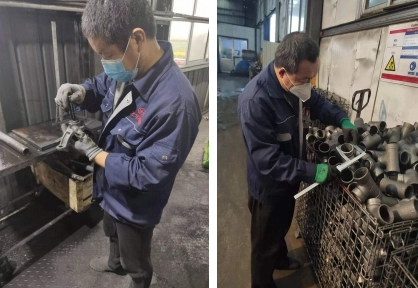
CNC lathes cut grooves and sealing faces to tolerances, with operators doing self-checks and inspectors sampling to spot tool wear early. Automated coating lines put down even protective finishes under set temperature and speed, checked by salt-spray and adhesion tests.
Multi-Layer QC Processes That Prevent Leaks and Reduce Environmental Impact
Raw inputs face spectral screening for manganese, sulfur, and tramp elements. Off-spec lots go back; repeated failures drop suppliers. Every melt batch gets complete metallographic review—samples cut, polished, and examined under optical microscopes for nodule count, ferrite level, and defect signs. Results out of range mean quarantine; the standing rule picks scrapping over any release.
Furnace-side monitoring with imported analyzers and accurate pyrometers holds composition and temperature. Sorting areas use several platforms for piece-by-piece checks. Good fittings go forward; defects sort by type to feed root-cause work and tweaks.
Air-tightness testing covers every fitting to catch blisters or porosity paths. Large diameters take 100 percent hydrostatic pressure per standard, smaller sizes get routine sampling to prove zero factory leakage. A secondary inspection zone adds another full pass. Threads check verticality and pitch with gauges. Over 100 instruments—from spectral units to burst rigs—carry the full sequence. Fluid Tech keeps about 20 percent of staff on quality work, showing how much weight goes to catching issues early.
Zero leakage trims environmental impact directly. No drips mean no wasted water, no cleanup chemicals, and no early replacement rounds. Samples kept for three years help ESG audits and prove compliance with growing carbon reporting needs.
2026 Industry Trends: Why Sustainable Grooved Piping Wins in Fire Safety
Fire protection holds more than half the grooved fittings market, with growth steady at 4.7 to 6 percent CAGR through the decade. Data centers, high-rises, and warehouses keep pushing the numbers, but all face rising carbon reduction demands. NFPA 13 and 25 updates focus on corrosion control and hydraulic precision, while LEED systems favor high recycled content and longer life.
Ductile iron grooved fittings answer without giving ground. Weld-free joints drop site emissions. Strong recyclability matches circular economy thinking. Rigorous quality control keeps performance solid over decades, skipping carbon costs from frequent remake cycles.
Actionable Guide: How to Choose and Specify Sustainable Ductile Iron Grooved Fittings
Buyers and engineers take clear actions to get sustainable outcomes.
Require FM, UL, CE, LPCB, or VDS listings with documented QT450-10 proof—ferrite percentages, spheroidization grades, and defect-free records. Ask for confirmation of 100 percent air-tightness and hydrostatic testing.
Dig into production controls. Question sand systems (Fondarc-level automation), automatic pouring, and layered inspection routines. Look for daily metallographic sampling and firm quarantine steps.
Check sustainability data. Request recycled content statements, lifecycle figures, and traceability records for carbon reports.
Review supplier setup. Site visits show if quality teams stay properly staffed and equipped. Steady supply chains lower chances of rushed runs that skip checks.
These steps lead to fittings that give safety and environmental value over long stretches.
Fluid Tech Piping Systems (Tianjin) Co., Ltd.: Specialized Provider for Fire Protection Piping
Fluid Tech Piping Systems (Tianjin) Co., Ltd., part of Fluid Tech Group since 2018, runs as a dedicated supplier in northern China for full fire protection piping packages. Tianjin-based with smooth warehousing, the company handles one-stop sourcing for contractors around the world.
The lineup focuses on ductile iron grooved fittings, backed by malleable iron fittings, grooved joints, valves, sprinklers, flexible drops, hangers, and seismic bracing. Exported items carry FM, UL, CE, LPCB, and VDS approvals, with facilities holding ISO, SGS, and TUV certifications.
Quality stays uniform through standardized procedures, technical help, and setups that fit performance with cost realities.
Conclusion
Ductile iron grooved fittings made under rigorous quality control bring together durability, high recyclability, and leak-free reliability in a way that suits sustainable fire safety piping. High recycled content, extended service life, defect-free production steps, and full verification cut environmental impact while meeting modern fire suppression reliability needs. As 2026 moves ahead with tougher codes and lifecycle carbon focus, these fittings give a reliable route to safety and sustainability.
FAQs
Why is ductile iron more sustainable than other materials for grooved fire protection fittings?
Ductile iron hits recycled content above 90 percent and recycles fully at end of life, while lasting decades to cut replacement waste and embodied carbon compared with plastics or less durable steels.
How does rigorous quality control prevent leaks in sustainable sprinkler systems?
Rigorous quality control clears casting defects with 100 percent air-tightness testing, metallographic checks on every melt batch, and multi-layer inspections, producing zero factory leakage that lowers water waste and stops early system replacement.
What QT450-10 requirements ensure long-term eco-friendly performance in grooved fittings?
QT450-10 calls for ferrite above 85 percent, spheroidization grade 3 or higher, and tight limits on five elements with no shrinkage porosity or pores, giving the strength and ductility for long service without frequent intervention or extra environmental load.
How can buyers verify a supplier’s ductile iron grooved fittings meet 2026 sustainability standards?
Buyers should get FM/UL certifications, QT450-10 compliance records, proof of 100 percent hydrostatic and air-tightness testing, recycled content statements, and information on advanced sand systems and multi-stage quality steps.