Choosing the right reducing component matters when a grooved piping system transitions from a larger pipe size to a smaller one. A grooved reducing coupling, concentric reducer, and eccentric reducer can all create that transition, but they differ in geometry, pipe alignment, installation length, and typical use. For fire protection, water supply, HVAC, and industrial piping, the best choice depends on space, orientation, system layout, and project specifications.
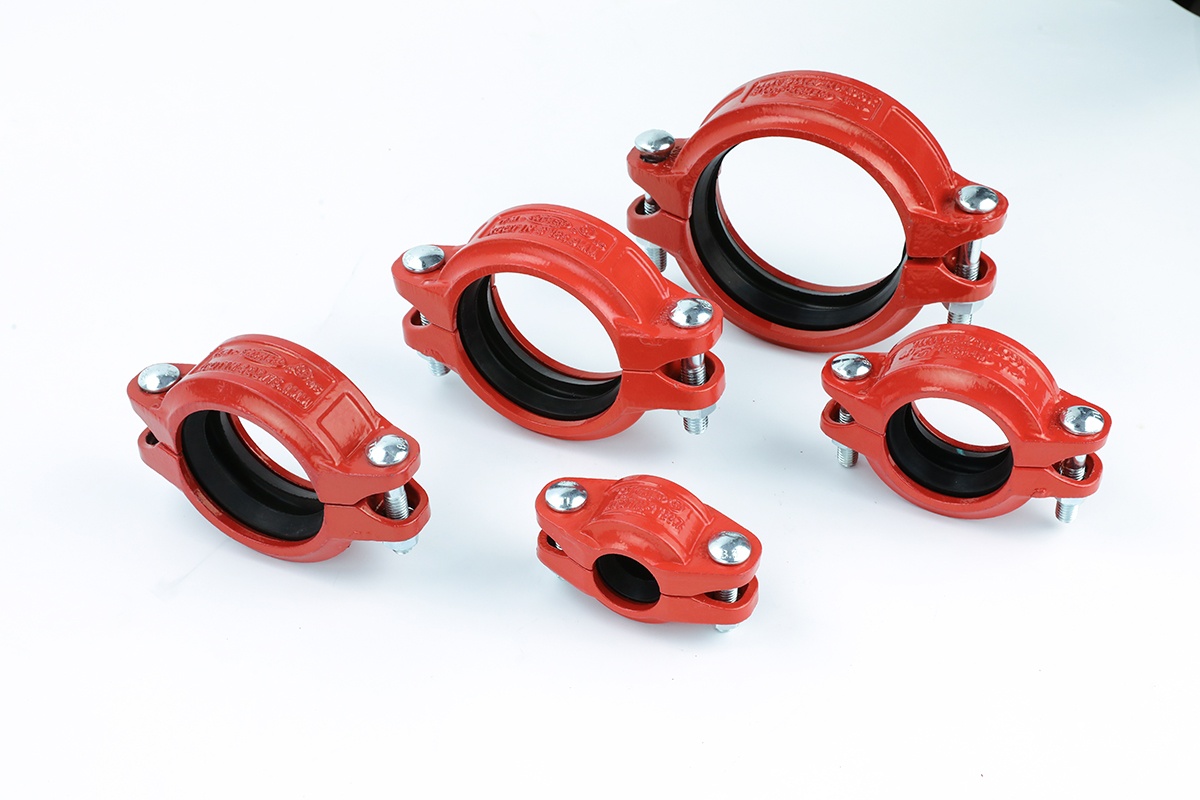
What Is the Difference Between These Three Grooved Reducing Options?
All three connect pipes of different diameters, but they solve different installation problems. FLUID TECH offers each type within its ductile iron grooved fitting range.
What Is a Grooved Reducing Coupling?
A grooved reducing coupling combines the pipe joint and size transition in one compact assembly. It connects two differently sized grooved pipe ends directly, so a separate reducer body and extra couplings may not be necessary.
This makes it attractive where space is limited or installers want fewer components. FLUID TECH lists its reducing coupling for fire sprinkler, water supply, HVAC, and industrial fluid piping applications.
What Is a Grooved Concentric Reducer?
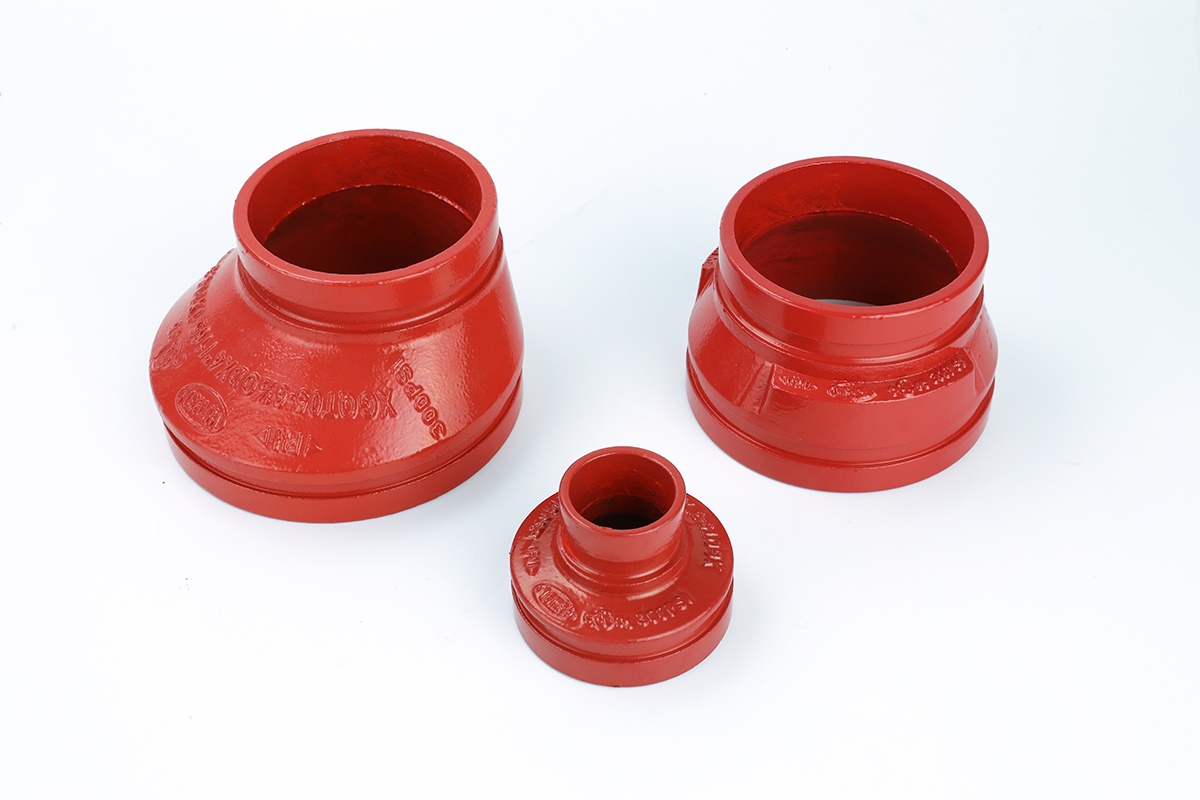
A grooved concentric reducer changes pipe diameter while keeping the larger and smaller pipe centerlines on the same axis. Its symmetrical body creates a centered transition.
This configuration is often suitable for vertical piping and layouts where centered routing simplifies supports or downstream connections. FLUID TECH offers multiple size and OD combinations for this type of reducer.
What Is a Grooved Eccentric Reducer?
A grooved eccentric reducer changes diameter while offsetting the two pipe centerlines. One side remains relatively flat while the opposite side forms the reduction.
The offset can be useful in horizontal piping where the design must control elevation, drainage, trapped air, or available clearance. FLUID TECH identifies its eccentric reducers for fire protection, water supply, HVAC, and industrial piping applications.
When Should You Choose a Grooved Reducing Coupling?
A reducing coupling is worth considering when compactness and installation efficiency are major priorities. The key question is whether the system actually needs a separate reducer body.
Choose It When Space and Part Count Matter
Because one component performs both joining and reducing functions, the assembly can be shorter and use fewer individual parts. This can be useful in mechanical rooms, risers, retrofit work, and other congested areas.
Before ordering, confirm both pipe ODs, pressure rating, groove dimensions, gasket compatibility, required approvals, and system medium. Nominal pipe size alone is not enough for reliable product matching.
When Should You Choose a Concentric or Eccentric Reducer?
The main decision between these two fittings is alignment. A concentric reducer keeps the centerline continuous, while an eccentric reducer intentionally creates an offset.
Choose a Concentric Reducer for Centered Alignment
If the smaller pipe should continue directly along the axis of the larger pipe, a concentric reducer is generally the cleaner choice. It is especially practical in vertical risers and centrally aligned pipe runs.
FLUID TECH publishes detailed size and OD combinations for its grooved concentric reducers, helping buyers verify dimensional compatibility before purchase. Its product range includes sizes from 2″ × 1″ through 8″ × 6″.
Choose an Eccentric Reducer When an Offset Is Required
For horizontal systems, reducer orientation may affect where air or liquid collects. An eccentric design allows one side of the pipe run to remain level while the other side transitions to the smaller diameter.
The correct orientation depends on the service and engineering design. Buyers should therefore confirm the flow medium, installation direction, pressure class, and project requirements before choosing the fitting.
How Can You Select the Right Option Faster?
A practical selection process should begin with the piping drawing rather than simply with a product name. Layout and dimensional requirements usually narrow the choice quickly.
Ask These Questions Before Ordering
Choose a grooved reducing coupling when you need a compact direct transition with fewer components. Choose a concentric reducer when both pipe sizes should remain on the same centerline. Choose an eccentric reducer when the smaller line needs to be offset.
Then verify the actual pipe OD, working pressure, groove standard, gasket material, required approvals, coating, and system medium. These checks help reduce mismatched fittings, unnecessary substitutions, and installation delays.
Where Can You Source Reliable Ductile Iron Grooved Pipe Fittings?
Once the fitting type has been selected, sourcing products from a supplier with a broad grooved piping range can simplify coordination across the project.
Why Consider FLUID TECH PIPING SYSTEMS (TIANJIN) CO.,LTD?
FLUID TECH PIPING SYSTEMS (TIANJIN) CO.,LTD supplies ductile iron grooved pipe fittings for fire protection and related piping systems. Its range includes grooved reducing couplings, concentric reducers, eccentric reducers, rigid and flexible couplings, elbows, tees, crosses, flanges, and other connection components. The company’s published reducer products include ASTM A536 ductile iron models and AWWA C606 grooved configurations.
For contractors, distributors, and project buyers sourcing several fitting types, working with a specialized supplier can make specification matching, quotation, documentation, and technical communication more efficient.
Conclusion
There is no single best reducer for every grooved piping system. A grooved reducing coupling fits projects where compact installation and fewer parts are priorities. A concentric reducer suits layouts requiring centered pipe alignment. An eccentric reducer is better when the transition must be offset for horizontal piping or specific layout requirements.
Start with the piping drawing, actual pipe OD, pressure requirement, groove specification, system orientation, and project approvals. Once these factors are confirmed, selecting the correct ductile iron grooved pipe fitting becomes much easier.
FAQs
Can a Grooved Reducing Coupling Replace a Concentric Reducer?
Sometimes, but not automatically. A reducing coupling provides a compact direct transition, while a concentric reducer maintains a defined reducer body and common centerline. Project layout, dimensions, required approvals, and engineering specifications should determine whether substitution is acceptable.
Can an Eccentric Reducer Be Installed Vertically?
It may be possible in some systems, but eccentric reducers are normally selected because an offset is needed. If a vertical run does not require that offset, a concentric reducer may provide a more direct and convenient alignment.
What Information Should I Provide When Ordering a Grooved Reducer?
Provide the large and small pipe sizes, actual outside diameters, working pressure, groove standard, required approvals, surface finish, system medium, and quantity. For an eccentric reducer, also state any orientation requirement that may affect installation.